
St. Charles Borromeo
Time Period:
1538-1584
Feast Day:
November 4
Title/Attributes:
Bishop and Cardinal, Confessor
Location of Relic:
Back Right Reliquary - Right Section
Type of Relic:
From the Cassock
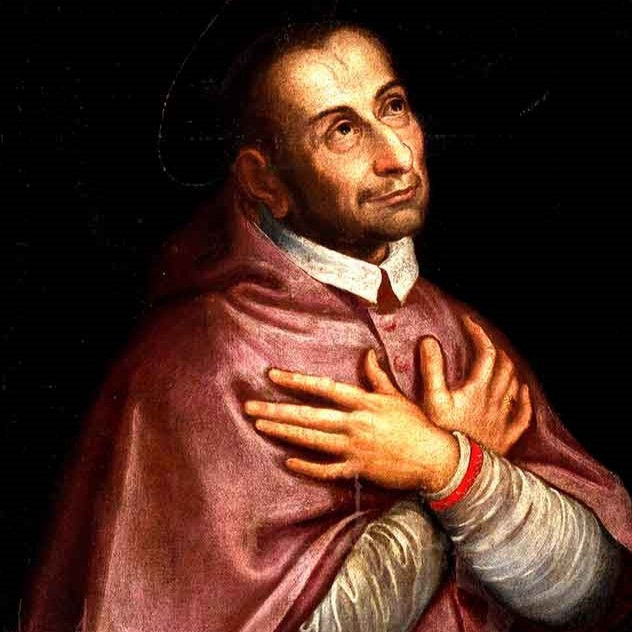
St. Charles Borromeo was a Cardinal and one of the towering figures of the Catholic Reformation. He was born on October 2, 1538, the son of Count Gilbert Borromeo and Margaret de Medici, the sister of Pope Pius IV. The castle of his family was called Arona and was located on Lake Maggiore, in Italy.
At the age of twelve, Charles was sent to the Benedictines of Arona for his education, having received the clerical tonsure. He studied in Milan and Paris, receiving his doctorate in civil and canon law in 1559. The following year he was named secretary of state by his uncle, Pope Pius IV, who also appointed him a cardinal and administrator of Milan. Charles served as a papal diplomat and urged Pius IV to reconvene the Council of Trent, which had been suspended in 1552. He played a leading role in the council, directing the writing of decrees and taking part in its deliberations.
His father died about that time, and Charles refused to assume the titles of his family. He was ordained a priest in 1563 and made bishop of Milan. He delayed going to his new see until the catechism, breviary, and missal called for by the Council of Trent were completed. Finally reaching Milan in 1566, Charles reformed the diocese in every capacity, aided the English College in Douai, France, and held six provincial councils and six diocesan synods. In 1578, he founded the Oblates of St. Ambrose, now called the Oblates of St. Charles.
In 1559, Charles was wounded by an assassin, Jerome Donati Farina, one of the many enemies of Charles’ rigorous reforms. The following year a famine struck the region, and he fed three thousand men, women, and children every day for three months. In 1576, he mobilized resources to aid Milan during a plague. The clergy and religious joined him as he went through the streets, caring for the stricken (the local government officials had fled the city). For almost a year, Charles cared for plague victims, going into debt to buy the necessities for the suffering. A vision informed him of the plague’s end.
In 1580, he aided the English priests going back to the British Isles, and in 1583 he served as apostolic visitor to Switzerland. He died on the night of November 3, 1584 in Milan.